Chapter I
The Western Front
Collieries emptied as the men of Oakdale answered the call, marching shoulder-to-shoulder straight into the slaughter of the Western Front.
The Beginning of WWI: The Early Campaigns
When the shadow of war fell in August 1914, the men of Gwent's valleys dropped their tools to answer the call. The Monmouthshire Regiment was split geographically into three battalions. The 1st Battalion drew its strength primarily from Newport and its immediate surrounding communities. The 2nd Battalion mobilized around Pontypool, Blaenavon, Abertillery, and Blaina, whilst the 3rd Battalion, with its headquarters in Abergavenny, gathered the rugged mining men from deep within the Western Valleys, including Ebbw Vale, Tredegar, Cwm, and Sirhowy.[1]
In this first chapter we cover the 10 major campaigns of the First World War where 23 men from Oakdale fought and died in the European theatre. (You may select below to go directly to that campaign.)
In this first chapter we cover the 10 major campaigns of the First World War where 23 men from Oakdale fought and died in the European theatre. (You may select below to go directly to that campaign.)
1914 – 1915
Early Trench Warfare in Flanders
The opening months of the First World War on the Western Front subjected the British Expeditionary Force to unprecedented violence, culminating in a desperate struggle for survival. Following the initial mobile battles of Mons and the Marne in 1914, the conflict rapidly stagnated into a brutal, subterranean war of attrition.[2] For the Territorial volunteers and regular soldiers of South East Wales, this initial phase of the war served as a swift and devastating introduction to modern combat.
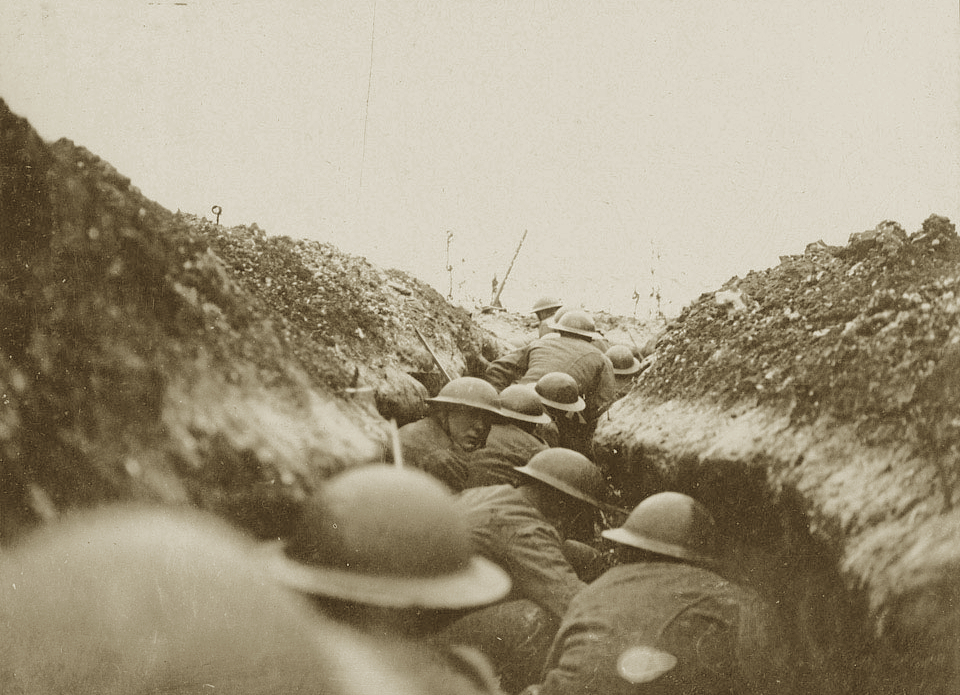
The region’s early response was spearheaded by regular battalions of the South Wales Borderers and the initial mobilization of the Monmouthshire Regiment’s three Territorial Force battalions. Drawn from the tight-knit Welsh mining valleys, these men dropped their tools in August 1914. While the regular battalions faced the initial German onslaught, the Territorials underwent intensive training before crossing the English Channel to reinforce the crumbling Allied lines.
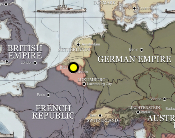
By late 1914 and early 1915, South East Welsh soldiers were holding critical, waterlogged sectors around Armentières and the Ypres Salient. Enduring the bitter winter freeze in primitive, muddy earthworks, they faced a constant barrage of sniper fire, heavy artillery, and mortar bombardment. It was during these grueling early months that the unique underground skillsets of the valley colliers became vital, as they reinforced unstable, collapsing trenches and constructed early deep-crust defenses.
This period of tense, localized defense served as the prelude to the horrific crucible of the Second Battle of Ypres in April 1915. The steady loss of life during these introductory campaigns sent shockwaves through South East Welsh communities, providing a stark, heartbreaking preview of the immense sacrifices that would soon define the region's wartime legacy.
The heavy toll of these early months claimed some of the valley's youngest volunteers, including 18-year-old Pte. Albert Stewart Price, who died of wounds on 5 April 1915. His sacrifice stands among the earliest recorded losses for Oakdale's serving soldiers on the Western Front.
22 April – 25 May 1915
Second Battle of Ypres
The Second Battle of Ypres marked a terrifying evolution in modern warfare. Launched by a massive German offensive on the Allied salient in Belgium, the battle is infamous for the first large-scale use of chlorine gas.[3] Amidst this atmospheric horror and relentless artillery bombardment, the Territorial soldiers of the Monmouthshire Regiment endured their most brutal baptism of fire.
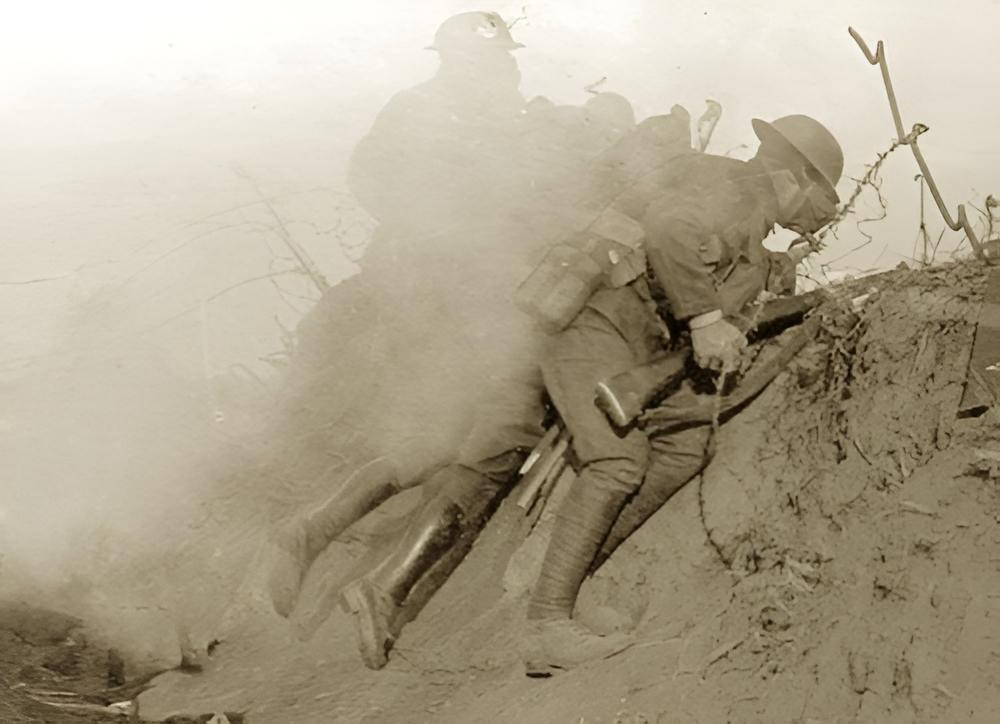
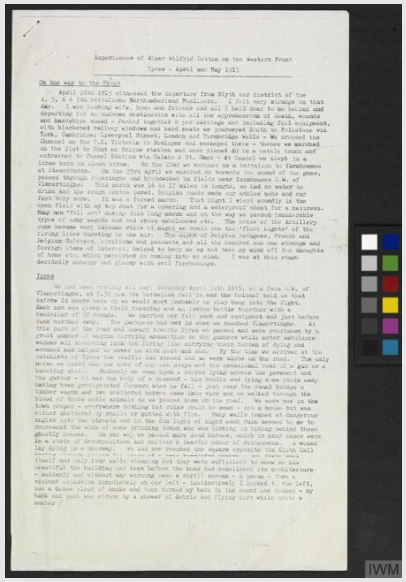
Composed of pre-war volunteers from the industrial valleys of South East Wales, the Monmouthshire Regiment's three battalions held critical sectors of the crumbling Allied line. While the 1st and 3rd Battalions faced devastating shellfire near Frezenberg and Polygon Wood, the 2nd Battalion was subjected directly to the terrifying green clouds of lethal gas.
Deployed to the shattered trenches near Wieltje and Shell Trap Farm on the northern ridges of the Ypres Salient, the men faced a horrific trial on 2 May 1915 during the height of the Second Battle of Ypres. Caught in a dense onslaught of drifting chlorine gas, they had no standard protection and were forced to rely on makeshift anti-gas defenses, breathing through damp cloths or urine-soaked rags to survive. Despite the agonizing chemical burning in their lungs and a relentless German infantry advance following the cloud, the battalion stood unyielding, paying a staggering price in dead, wounded, and asphyxiated comrades to prevent a catastrophic enemy breakthrough.
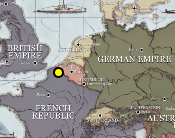
The climax of the regiment’s fight occurred during the Battle of Frezenberg in May. Tasked with holding the line against overwhelming forces, the 3rd Battalion made a gallant stand near a local ridge where they were ordered to hold the ground to the very last man. They obeyed at a catastrophic cost, refusing to yield an inch of territory. By the time the battle subsided, the regiment was shattered.
The slaughter was unimaginable; the 3rd Battalion was reduced from over 1,000 men to just 134 survivors. The losses were so absolute that on 27 May 1915, the remnants of all three units had to be temporarily amalgamated into a single composite battalion just to remain operational.[4]
The brutal cost of these defensive operations—especially during the catastrophe of 8 May 1915, is remembered in the valleys as "Monmouthshire's Black Day" and immortalized in the sacrifice of our local men: Pte. Frederick John Symons, Pte. Thomas Benjamin Havard, and Pte. Phillip Arthur Williams, all killed in action during the desperate defense of Frezenberg Ridge and Verlorenhoek and commemorated on the Menin Gate; alongside L/Cpl. George Lovell killed in action on 13 May 1915, who rests in the Bailleul Communal Cemetery Extension.
December 1915 – May 1916
Givenchy-lès-la-Bassée Sector
The Givenchy-lès-la-Bassée sector was one of the most notoriously grueling and waterlogged stretches of the Western Front. Following the catastrophic losses suffered at Ypres in 1915, the 1st Battalion of the Monmouthshire Regiment was moved south to this treacherous landscape. It was here, in the late summer and winter of 1915, that the unique skills of the soldiers from South East Wales transformed the physical nature of the war.
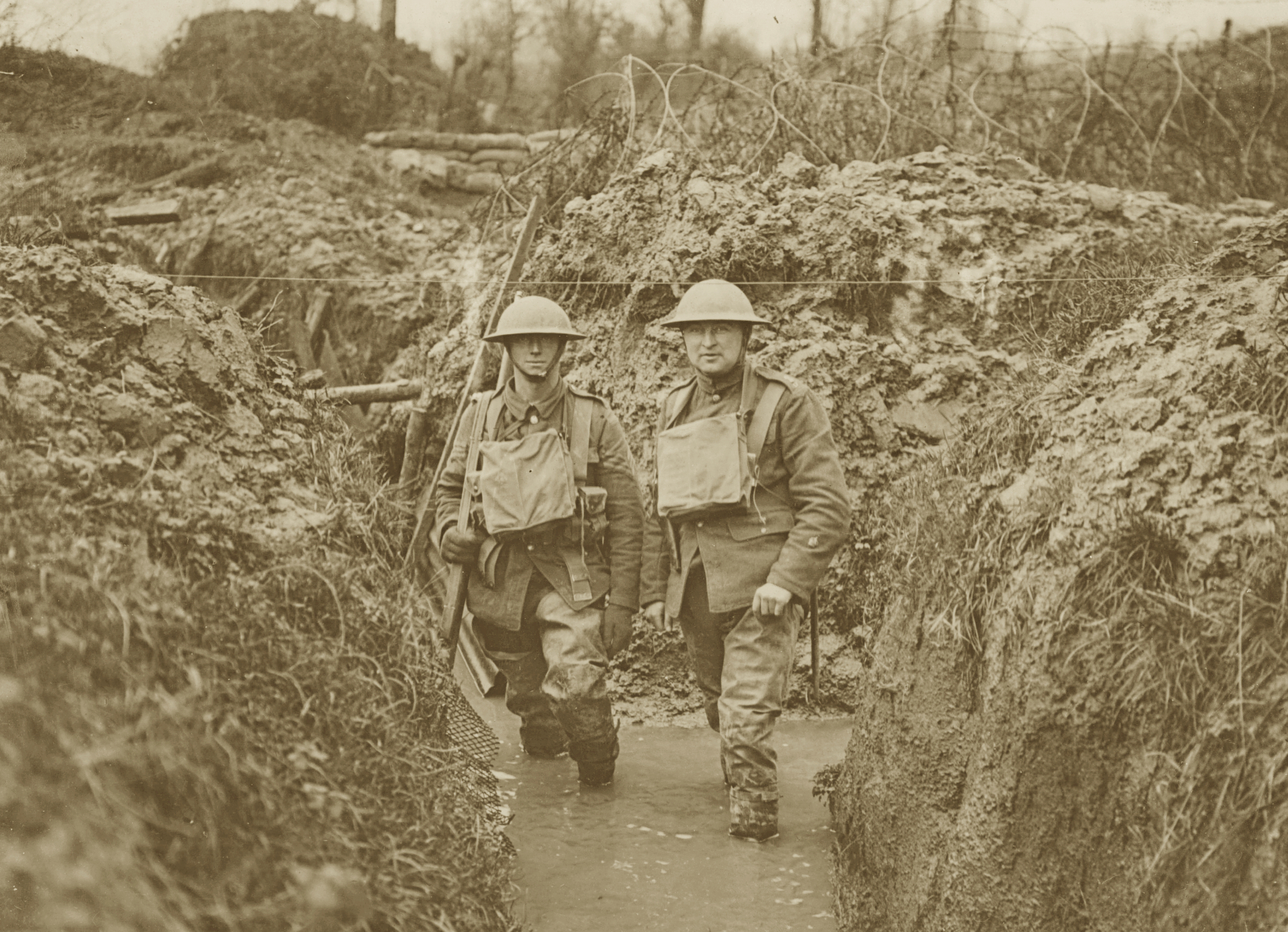
The frontline at Givenchy was characterised by a brutal combination of flooded trenches, relentless sniper fire, and subterranean mine warfare. For the tough colliers and laborers drawn from the Gwent valleys, this nightmarish environment shared a dark familiarity with their lives back home. In the claustrophobic, gas-choked galleries beneath No Man's Land, these men applied their civilian skills under the constant threat of tunnel collapses and enemy camouflets. Recognizing their unparalleled expertise in deep-crust excavation and underground timbering, the military leadership officially designated the 1st Battalion as a Pioneer Battalion, tasking them with the vital structural engineering and tunneling operations required to hold the line.[5]
Rather than just enduring enemy shellfire, the South East Welsh soldiers actively reshaped the battlefield. Utilizing their skills, they dug extensive communication trenches through unstable mud, drained collapsing earthworks, and counter-mined against German engineers attempting to detonate explosives beneath British lines. Their efforts were physically agonizing, carried out in pitch-black, within suffocating tunnels and beneath a constantly bombarded landscape.
The defense of Givenchy demanded an immense, grinding sacrifice. While the sector lacked the singular, massive grand offensives of the Somme, it claimed lives daily through sudden sniper rounds, mortar bursts, and underground cave-ins. The unwavering endurance of the Monmouthshire pioneers at Givenchy cemented their reputation not just as fierce combatants, but as the indispensable backbone of the Western Front’s subterranean fortress.
Throughout the winter of 1915 and into the spring of 1916, the division held the strictly contested, waterlogged trenches of the Armentières and Givenchy-lès-la-Bassée sectors. It was during this period of grueling trench holding, local skirmishing, and constant shelling that Pte. John T. Williams sustained the injuries that ultimately led to his passing at the Merville casualty hub in May 1916.
1 July – 18 November 1916
Battle of The Somme
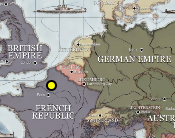
The Battle of the Somme lasted 141 days (nearly 5 months) and stands as one of the most infamous and costly campaigns of the First World War. Launched as a massive joint offensive combining British and French forces to break the German lines in northern France, its opening day remains the bloodiest in British military history. Among the waves of men who climbed out of the trenches into a storm of machine-gun fire were thousands of soldiers from the valleys of South East Wales.
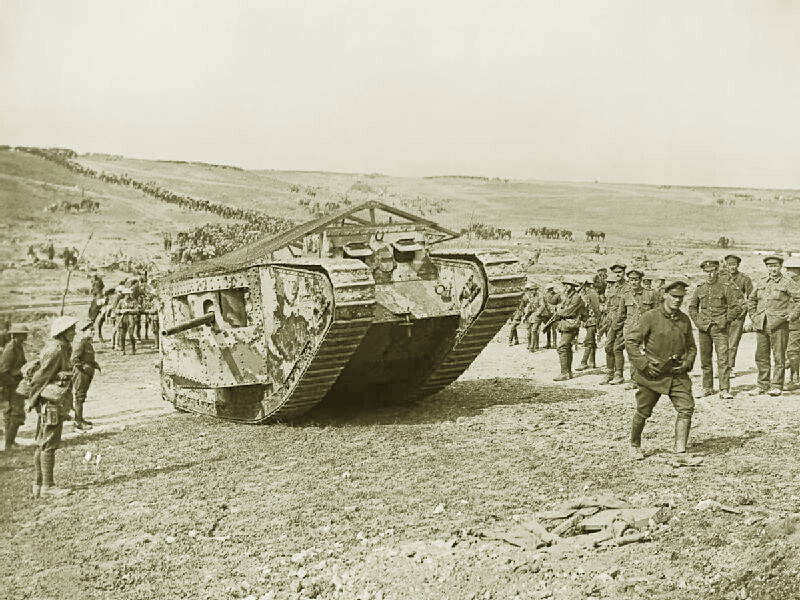
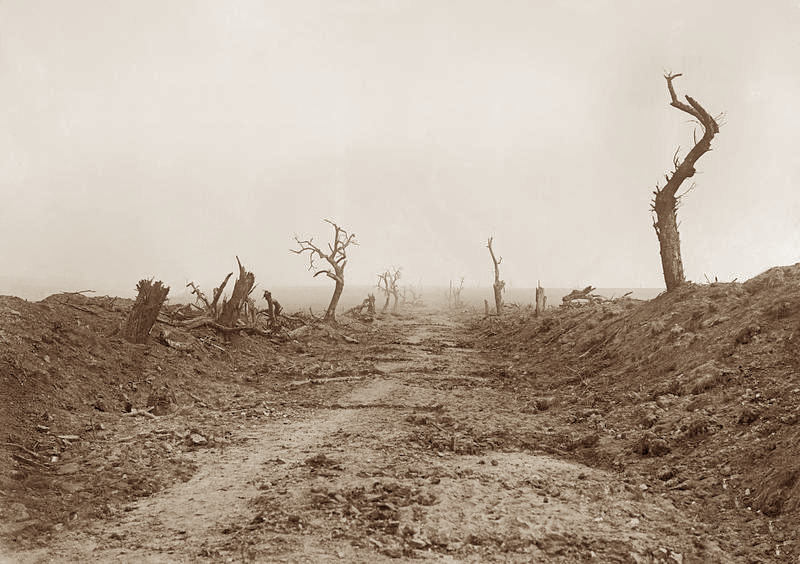
The region’s sacrifice was largely borne by the 38th (Welsh) Division, which included battalions of the South Wales Borderers and the Welsh Regiment. These units were filled with the tough, tight-knit colliers, steelworkers, and laborers who had traded the mines of Gwent, Glamorgan, and Monmouthshire for the mud of the Western Front.
The defining crucible for these South East Welsh soldiers occurred early in the offensive, in July 1916, at Mametz Wood. Tasked with clearing a heavily fortified, dense forest bristling with hidden German machine-gun nests, the Welsh division advanced across open ground under relentless artillery fire. For days, the fighting inside the wood was a savage, hand-to-hand nightmare amidst splintered trees and thick undergrowth. [6]
Despite suffering staggering losses, the men of the valleys displayed monumental resolve, eventually clearing the stronghold. However, the victory came at a devastating cost; the 38th Division suffered over 4,000 casualties in that single action. Back home, entire communities were plunged into mourning as the telegrams arrived, revealing that generations of neighbors, friends, and brothers had fallen side-by-side in the shattered remains of Mametz. [7]
But Mametz was only the beginning, and as the battle ground on into the freezing autumn mud, other Oakdale men found themselves dispersed among different regiments. Fighting with units like the Royal Irish Fusiliers, they endured relentless later phases of the wider offensive, including the fierce engagements at Guillemont and Flers-Courcelette. Sustaining this grinding advance also required monumental manual labor under fire; Pioneer battalions worked day and night to carve trenches, lay communications cables, and build infrastructure through the devastation.
The devastating cost of the broader Somme Campaign echoed deeply in the Sirhowy Valley, claiming the lives of five local men. This staggering loss is immortalized by soldiers such as Pioneer Edmund S. Rowlands, Pte. Michael Farrell, Lance Corporal John Richard John, Pte. Earnest Prosser, and Pte. William Charles John, all of whom fell during the relentless 1916 operations.
The Grinding War & Final Push
By the dawn of 1917, the patriotic fervor of the early war years had been replaced by the grim reality of the ongoing slaughter. The men of the Monmouthshire Regiment were no longer raw recruits; they were battle-hardened Pioneer veterans. As the conflict stretched into its final, desperate phases, the surviving colliers from Oakdale and the Western Valleys were thrust into the most grueling campaigns of the Western Front. From the suffocating mud of Flanders to the mechanized fury of the war's final months, these men endured the unimaginable.
Spring & Summer 1917
Lens Sector & Attack on Lens
The Attack on Lens and the surrounding coalfields of the Pas-de-Calais became a crucial and deeply symbolic sector for the soldiers of South East Wales during the later years of the First World War. Long before the official August offensive to capture Hill 70, battalions from the Monmouthshire Regiment, the South Wales Borderers, and the Welsh Regiment were rotated into this heavily industrialised landscape to hold the line, dig saps, and endure daily attrition.[8]
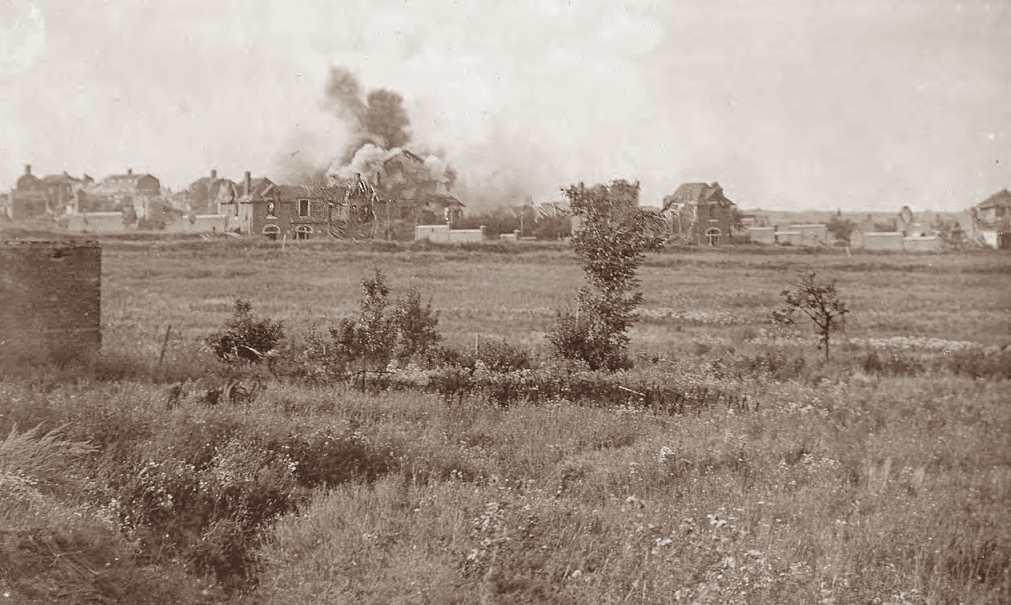
A shell bursts in the outskirts of Lens.
Photo credit: Canadian Military History, Vol. 17 [2008]
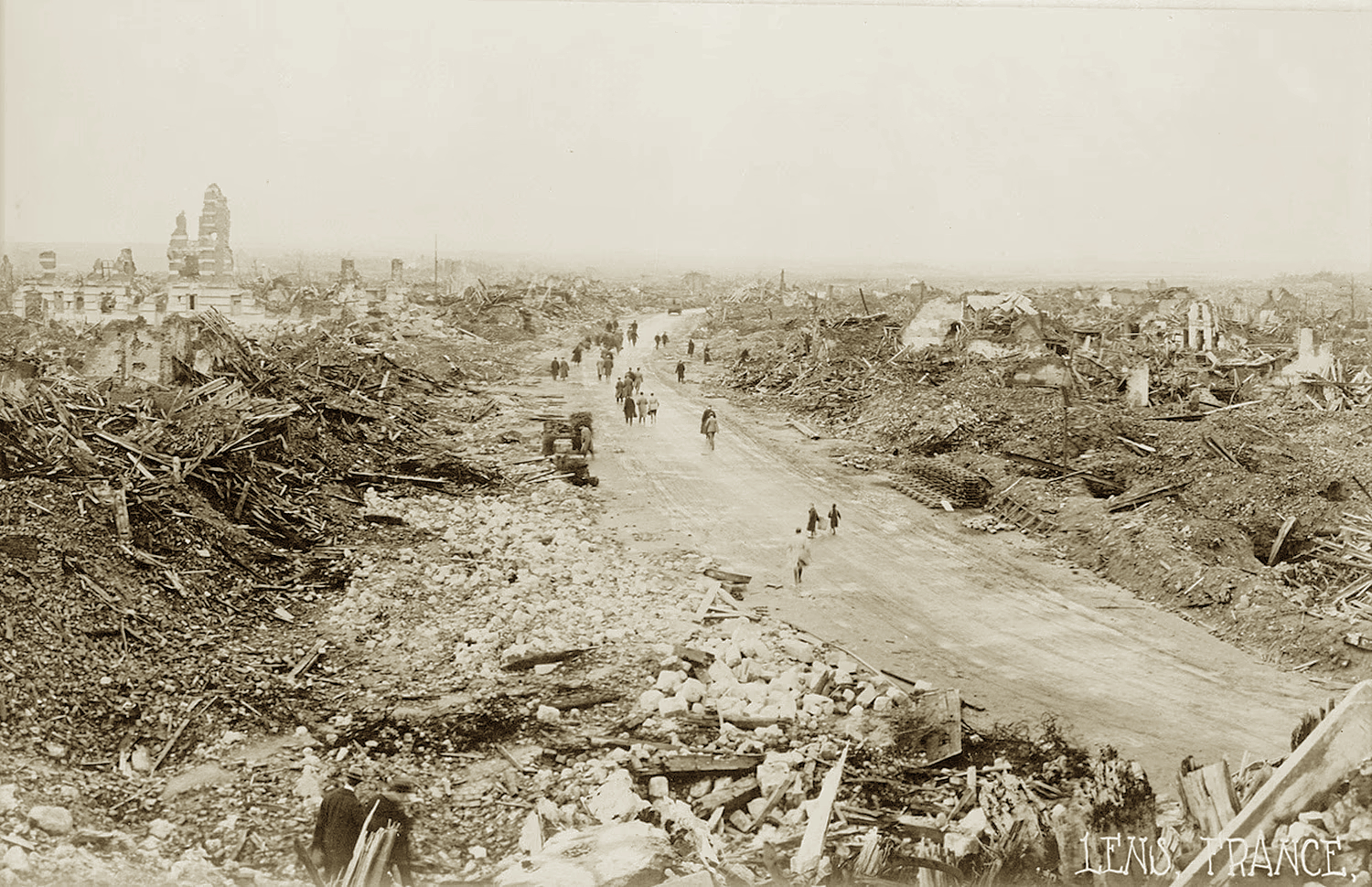
For the colliers and industrial workers of Gwent and Glamorgan, the landscape around Lens was intimately familiar yet nightmarishly corrupted. The battlefield was dominated not by open fields, but by towering slag heaps (fosses), shattered pithead winding gear, and the ruined mining cottages of northern France. The defense of this sector required holding fortified slag heaps—such as the infamous Hill 70—under a relentless deluge of high-explosive artillery, machine-gun fire, and devastating mustard gas attacks.
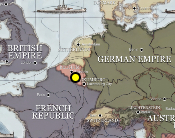
The industrial expertise of the South East Welsh soldiers proved invaluable in transforming these devastated collieries into heavily fortified defensive bastions. Using their subterranean skills, miners from the valleys carved deep, stable bunkers beneath the slag heaps and reinforced collapsing underground tunnels under heavy bombardment. They successfully turned a ruined industrial wasteland into an impenetrable fortress line, effectively blocking German attempts to reclaim the vital coal region.
This static, attritional defense came at a severe cost. The daily realities of trench warfare, gas saturation, and sudden raids exacted a steady toll on the men of South East Wales. Entire mining communities back home frequently received devastating news of casualties suffered in a landscape that mirrored their own valleys. The resolute stand at Lens further cemented the legacy of the South East Welsh battalions as resilient, versatile soldiers capable of mastering both the traditional and subterranean horrors of the Western Front.
The physical toll of operating in a landscape choked with poison gas and pulverized debris was immense. Pioneers like Pte. William Jones Onions and Rifleman Wyndham Workman worked exhaustively to maintain the defensive network and fell during these claustrophobic engagements.
July – November 1917
Passchendaele (Third Battle of Ypres)
The Third Battle of Ypres, infamously known as Passchendaele, stands as the ultimate symbol of the horrific mud and attrition that defined the Western Front. Launched with the strategic goal of breaking through the German lines into Belgium in order to destroy enemy submarine bases, the offensive quickly dissolved into a nightmarish, swamp-like landscape.[9] The battle itself lasted 103 days and left an estimated 250,000 British soldiers dead, wounded, or missing, alongside staggering German losses. Among the soldiers tasked with advancing through this apocalyptic terrain were thousands of men from South East Wales, primarily serving in the 38th (Welsh) Division.
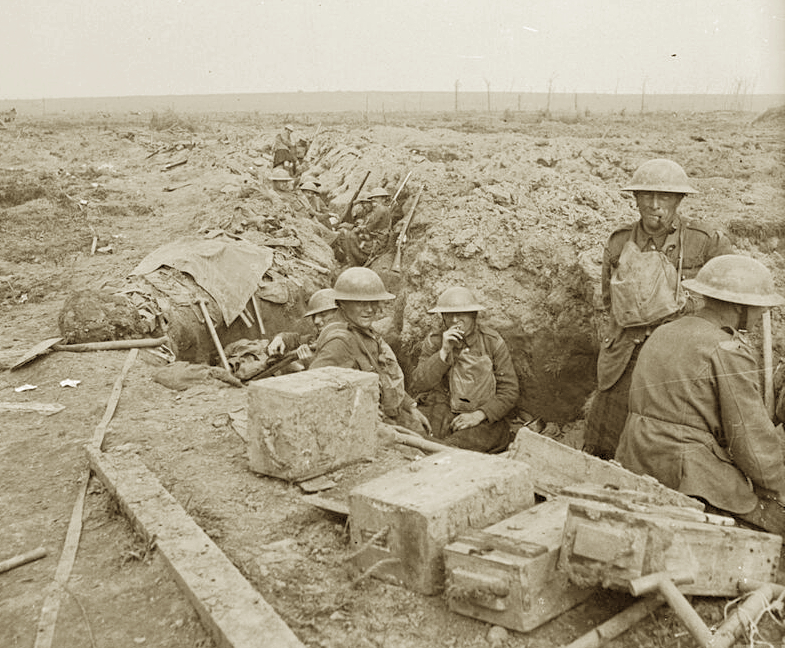
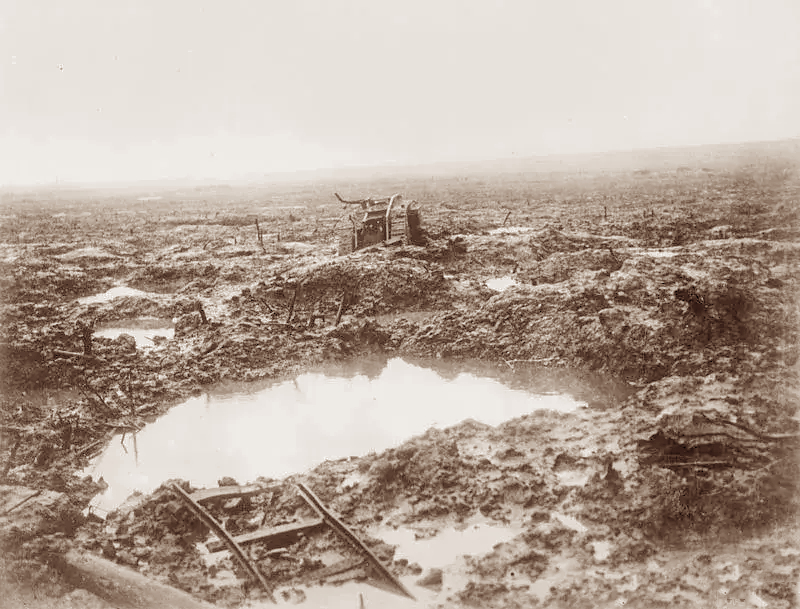
For the men of the Gwent valleys, Passchendaele presented physical conditions of unimaginable brutality. Weeks of unprecedented rainfall combined with relentless artillery bombardments completely destroyed the low-lying drainage systems of Flanders, turning the battlefield into a vast sea of deep, suffocating mud. Soldiers had to navigate narrow wooden duckboards to avoid drowning in water-logged shell craters, all while carrying heavy equipment under a constant deluge of machine-gun fire and mustard gas.
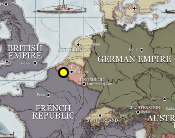
The South East Welsh battalions are remembered for their courage on the opening day of the offensive at the Battle of Pilckem Ridge. Advancing directly into the powerful machine-gunfire of heavily fortified German concrete pillboxes, the men of the South Wales Borderers and the Welsh Regiment displayed monumental courage. On the first day of the battle alone, three Welsh soldiers were awarded the Victoria Cross for their actions, one of them posthumously. Despite the monumental difficulties, they successfully stormed the ridge and captured their objectives, but the human cost was staggering.[10]
The Welsh division suffered nearly 3,000 casualties as they stormed Pilckem Ridge. Back home in South East Wales, the catastrophic loss of life deeply impacted tight-knit mining communities, leaving behind a legacy of profound grief and cementing Passchendaele as a testament to the supreme endurance and tragic sacrifice of the valley men.
The tragedy of Passchendaele struck deeply into the heart of Oakdale, as families received news that their sons had been swallowed by the Flanders mud. In these apocalyptic conditions, local men including Private Gilbert Phillips, Private Thomas G. Coombs, and Private David J. Rees gave their lives.
December 1917 - February 1918
Battle of Cambrai
Fought on the Western Front, the Battle of Cambrai stands as a revolutionary milestone in military history. Intended to break the bloody trench deadlock of the Hindenburg Line, the British Third Army launched a surprise offensive using unparalleled tactics. For the first time, over 400 Mark IV tanks were massed alongside sophisticated, unregistered artillery barrages and air support. The initial strike achieved a stunning four-mile breakthrough in just hours, causing church bells to ring out in celebration across Britain. However, the advance soon stalled at Bourlon Ridge due to poor coordination. Unfortunately, a massive German counter-attack on 30 November recaptured most all of the hard-won ground, resulting in over 44,000 British casualties.[11]
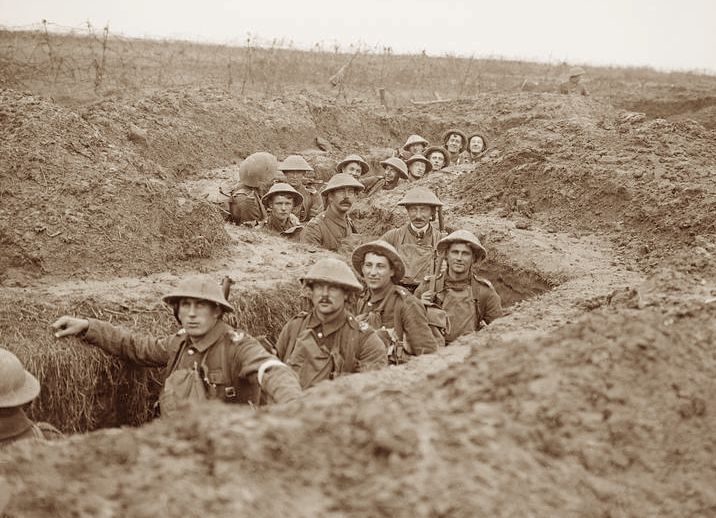
Amidst this mechanised chaos, the human cost was borne intensely by communities across South East Wales. Men from the industrial valleys of Monmouthshire and Glamorgan, including coal miners and steelworkers who had traded their picks for rifles and fought tenaciously in the mud. Battalions from the Welsh Regiment, the Welsh Guards, and the local Monmouthshire Regiment were thrust directly into the maelstrom.
South East Welsh soldiers faced bitter close-quarters fighting in places like Bourlon Wood and the heavily contested "Welsh Ridge" near Villers-Plouich. Amidst the shattered, snow-dusted treelines and frozen chalk trenches, these men had to endure relentless hand-to-hand combat and persistent mustard gas that clung heavily to the undergrowth. The shifting front lines required constant, desperate defensive stands to prevent the German stormtroopers from rolling up the Allied flanks.
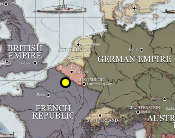
On 1 December, the 1st Battalion Welsh Guards advanced into a lethal hail of hidden machine-gun fire at Gouzeaucourt, losing scores of men in the opening minutes. Undertaking a desperate counter-attack up the exposed, icy slopes without their promised tank support, the battalion was mercilessly cut to pieces by entrenched enemy positions. Yet, despite suffering an agonizing 270 casualties in a matter of moments, the survivors stubbornly held their ground, stabilizing a critical breach in the line until they were finally relieved.
The names of those who never returned are permanently etched on the Cambrai Memorial at Louverval, which bears the names of dozens of Monmouthshire Regiment men with no known grave. While Cambrai proved the tactical blueprint for eventual Allied victory in 1918, for the tight-knit communities of South East Wales, it remained a profound tragedy of sacrifice and unmatched bravery.
The bitter frost and brutal fighting turned the battlefield into a lethal proving ground. Lost in this ferocious back-and-forth struggle, Oakdale soldiers like L/Cpl. Ernest Havard and Pte. Frank Shaw are among those named on the Cambrai Memorial at Louverval.
March – April 1918
German Spring Offensive
Launched in March of 1918, Germany’s final, desperate attempt to win World War I consisted of five major strikes at the Western Front before American troops arrived in force. Operation Michael, the opening blow, utilized elite "stormtrooper" tactics, devastating gas bombardments, and heavy morning fog to shatter the Allied front lines along the Somme. The British Fifth Army faced its most critical crisis of the war, suffering over 160,000 casualties in the first week alone as entire units were isolated, bypassed, and forced into a desperate, chaotic retreat across miles of devastated terrain.[12]
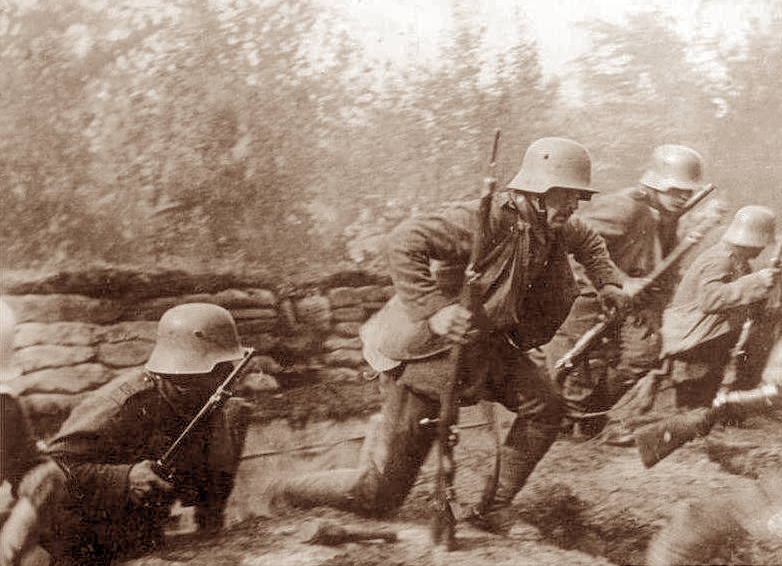
Among those thrust into this terrifying whirlwind were thousands of men from South East Wales. Miners, dockers, and ironworkers from the Gwent valleys filled the ranks of the 38th (Welsh) Division, the Monmouthshire Regiment, and the South Wales Borderers. These civilian-soldiers, accustomed to the brutal camaraderie of heavy industry, suddenly found themselves serving as the thin, battered shield tasked with slowing down the spearhead of the German elite forces.
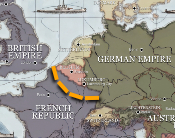
On the opening day of the offensive, the 2nd Battalion of the South Wales Borderers faced the full brunt of the onslaught near St. Quentin. Outnumbered and choked by gas, Welsh soldiers fought tenacious rearguard actions, holding vital bridges and crossroads along the Crozat Canal to allow the main army to escape encirclement. Fighting on empty stomachs, with water bottles long depleted and rifles scaling with heat, they stubbornly traded ground for time against a relentless enemy.
The sacrifice of South East Wales was immense. In the frantic retreats across the old, scarred Somme battlefields, entire platoons from the Monmouthshire battalions were completely cut off and overwhelmed, stubbornly fighting to the last bullet in isolated farmhouses and shell craters. Hundreds of young men from tight-knit valleys like the Rhymney, Sirhowy, and Ebbw were killed, wounded, or captured in a matter of days. Their resistance, however, bought crucial hours for the Allies to stabilize the line before Amiens. While the German offensive ultimately collapsed due to exhaustion and supply failures, the price paid by South East Wales was a devastating wave of grief that altered its industrial communities forever.
It was a war of movement that had not been seen since 1914. Bridges were blown, supply dumps were torched, and units were entirely cut off in the confusion. As British and Empire forces struggled to stabilize the crumbling line, the casualties spiked dramatically. Men from Oakdale Pte. Arthur Owens and Gunner George Wiltshire, fell during this harrowing withdrawal, buying precious time for the Allied lines to finally hold outside of Amiens.
August – November 1918
100 Days Offensive
The 100 Days Offensive, launched in August 1918, was the definitive and victorious final campaign of the First World War. Beginning with the stunning Allied breakthrough at the Battle of Amiens, a series of coordinated, relentless assaults shattered the German Army's resolve and forced a total retreat across France and Belgium. This final phase completely abandoned the stagnant trench warfare of previous years, evolving into a highly sophisticated, fast-moving war of combined arms. For the first time on a massive scale, massed tanks, tactical aircraft, overwhelming creeping artillery barrages, and elite mobile infantry operated in precise unison to breach previously impenetrable defenses.[13]
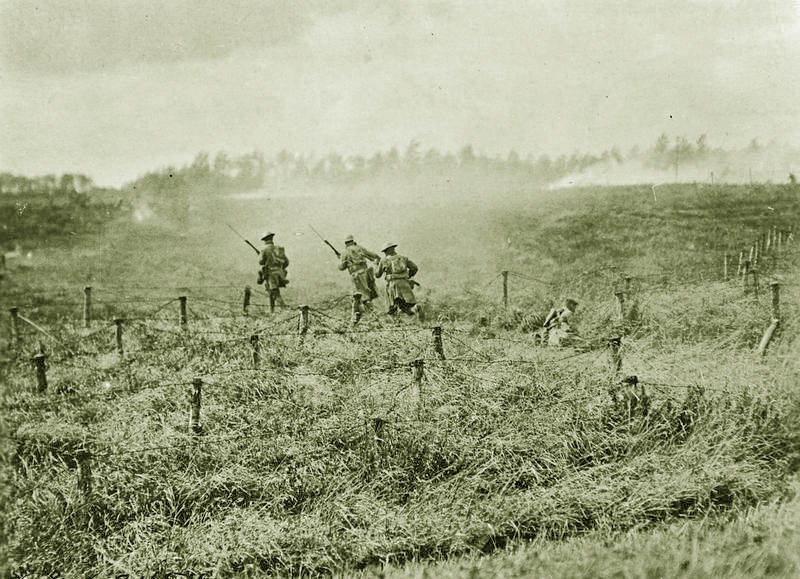
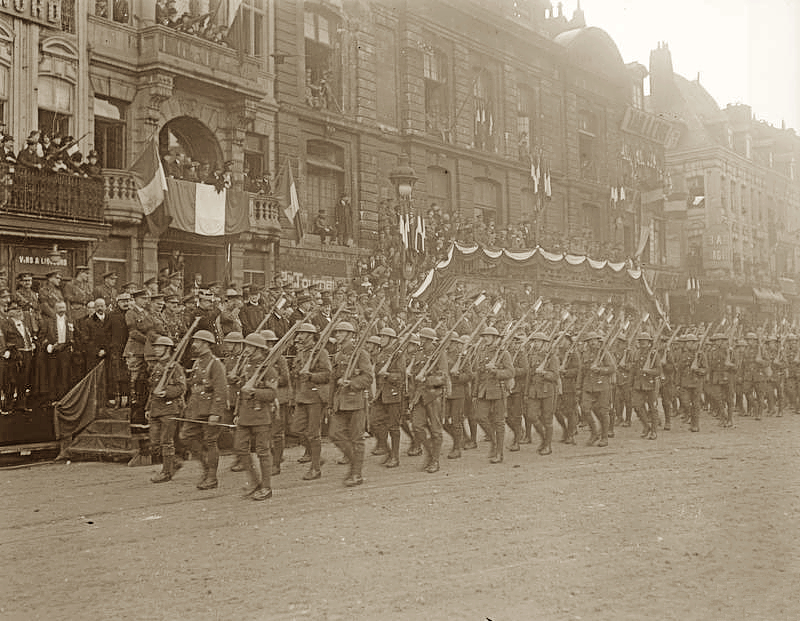
At the very vanguard of this historic push were the battle-hardened soldiers from South East Wales, whose resilience had been forged through years of bitter conflict. Serving proudly within the 38th (Welsh) Division, the South Wales Borderers, the Welsh Guards, and the Monmouthshire Regiment, these men—hailing from Cardiff, Newport, and the industrial heartlands of the Gwent valleys—played a pivotal role in the advance. Their campaign began with a legendary feat of arms on 21 August, when they crossed the flooded, heavily defended River Ancre under a torrential hail of enemy fire. In a triumphant display of grit, they successfully recaptured the blood-soaked terrain of Mametz Wood and Thiepval Ridge, proudly reversing the painful, catastrophic losses their regiments had suffered there in 1916.
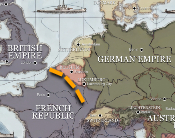
As the offensive surged eastward, South East Welsh battalions demonstrated immense tactical skill and bravery in breaking the formidable Hindenburg Line. In these final battles, the unique civilian skills of Welsh miners, colliers, and ironworkers proved invaluable, as they used their engineering expertise to rapidly bridge rivers, clear heavily mined roadways, and neutralize complex concrete bunker systems. Working alongside pioneering units, they cleared paths through dense belts of barbed wire and fortresses of reinforced concrete, driving the enemy out of deep subterranean strongholds that were meant to be unassailable.
The cost of this rapid victory, however, remained agonizingly high as the German army fought a desperate, bloody rearguard action to the very end. During the fierce, waterlogged fighting at the Canal du Nord, Épehy, and the River Selle, tight-knit communities in valleys like the Ebbw, Rhymney, and Sirhowy were struck by a final, devastating wave of casualty telegrams just weeks—and sometimes days—before the cessation of hostilities. When the guns finally fell silent at 11:00 am on 11 November 1918, the surviving men of South East Wales stood victorious on the Belgian border near Sambre and Mons. They had secured an Allied triumph through unparalleled endurance, leaving behind a legacy of ultimate sacrifice that would be permanently etched into the war memorials of their home valleys.
The physical toll of constant marching and daily combat was staggering. Pushing relentlessly across Picardy and back into the pulverized landscapes around Cambrai, the Allied forces faced fierce, determined rearguard resistance from German machine-gunners. During these final, victorious but incredibly costly months of continuous motion, Oakdale soldiers such as Pte. William Paulk and Pte. Jehoida Daniels laid down their lives just as the end of the conflict finally came into sight.
September – October 1918
Assault on the Hindenburg Line
Launched on 29 September 1918, the assault on the Hindenburg Line was the climactic masterstroke of the 100 Days Offensive. The Hindenburg Line was Germany’s most formidable defensive network, a vast system of deep concrete bunkers, machine-gun nests, and wide belts of barbed wire. Breaking it was deemed nearly impossible, yet failure meant a prolonged, bloody war into 1919. In a massive combined-arms effort, British, Australian, and American forces launched a titanic assault that successfully smashed through these final defenses, shattering the German army's morale and forcing the ultimate path to the Armistice.[14]
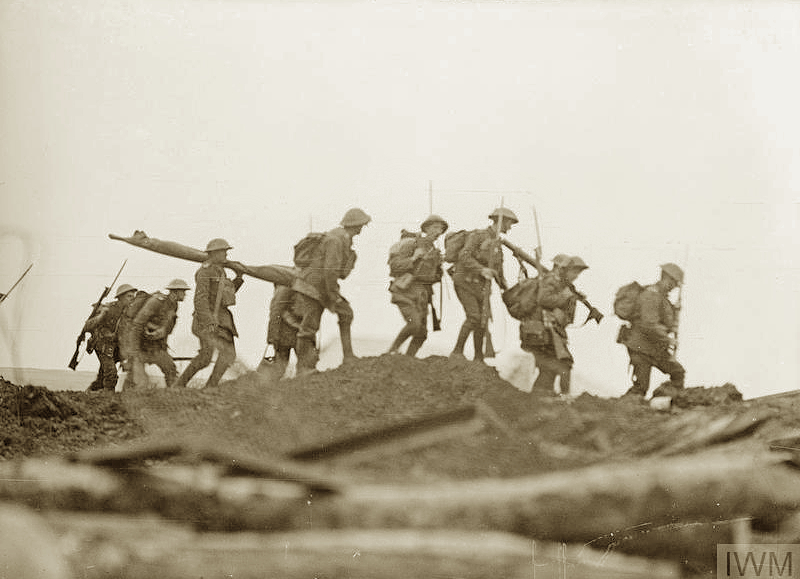
Soldiers from the 38th (Welsh) Division, the South Wales Borderers, and the Monmouthshire Regiment were directly in the crucible of this historic breakthrough. Facing the daunting task of clearing heavily fortified sectors, their background in coal mining and heavy industry proved invaluable. Used to working under extreme physical duress, Welsh engineers and infantrymen systematically neutralized subterranean concrete dugouts and reinforced tunnel complexes that the Germans had spent years perfecting.
The fighting was brutal and costly. South East Welsh battalions faced relentless machine-gun fire and devastating artillery barrages around key sectors like the Canal du Nord and the St. Quentin Canal. Companies from Newport, Pontypool, and Ebbw Vale suffered severe casualties as they stormed across open ground to secure vital bridgeheads. Despite the losses, their fierce determination broke the German spine. By piercing this impregnable barrier, the men of South East Wales helped deliver the decisive blow of the war, proving that the grit of the Welsh valleys could conquer the strongest fortress in Europe.
Nowhere was this industrial grit more evident than at the St. Quentin Canal near Riqueval and Bellenglise, where the 1/1st Battalion of the Monmouthshire Regiment served as the divisional Pioneers. Tasked with bridging a deep, heavily defended water obstacle that the German high command considered completely impassable, these Welsh colliers worked directly under a torrential hail of machine-gun fire. Utilizing their civilian expertise in rapid rigging and structural carpentry, they manufactured and threw forward primitive floating bridges, scaling ladders, and lifebelts. Their desperate engineering triumph allowed the assaulting infantry to cross the canal and breach the main line within hours, a feat now remembered as one of the finest tactical achievements of the British Army.
It was a profound tragedy that as the German military apparatus finally began to collapse and the promise of peace became a reality, the valley continued to lose its sons. During the brutal assault on Épéhy, 19-year-old Pte. Milson Ellway was killed in action. He would become the last Oakdale man to fall on the Western Front, dying just weeks before the guns finally fell silent in November 1918.
Chapter I Notes
- [1] UK Parliament Legislation, The Territorial Force Act 1908. ⮥
- [2] National Army Museum: World War I. ⮥
- [3] Imperial War Museum (IWM): Second Battle of Ypres. ⮥
- [4] The Long, Long Trail, The Monmouthshire Regiment. ⮥
- [5] The Long, Long Trail, Tunnelling Companies of the Royal Engineers. ⮥
- [6] BBC News / Wales, Battle of Mametz Wood. ⮥
- [7] Wikipedia, Battle of the Somme. ⮥
- [8] Western Front Association: Battle of Hill 70. ⮥
- [9] BBC News / Wales: Passchendaele 100: Mud and Welsh honours. ⮥
- [10] Britannica: Battle of Cambrai. ⮥
- [11] Mercian Regiment Museum: The Kaiserschlacht: German Spring Offensive 1918. ⮥
- [12] National WWI Museum and Memorial: The 100 Days Offensive. ⮥
- [13] Assault on the Hindenburg Line: 100 Days Operational Overview. ⮥
- [14] CWGC Casualty Record: Official 100 Days Offensive operational logs. ⮥